Monday, 9 September 2013

Just Like Grandma

My Grandma has been a hugely influential figure in my life. She has been a great role model to me in life, love, faith and the kitchen. When I would go over as a child to the farm she and grandpa lived on it seemed we would always end up baking or making something. Tea biscuits, cookies for every occasion (Halloween, Valentines, Spring, Friday....you get the idea), and applesauce; delicious, warm, apple sauce. Its come to the point in time at Hill Giant Farm when our apples and pears are finally beginning to ripen enough to be processed. Today I thought of my Grandma a lot as I used her Apple-saucer to make my yummy pear sauce.

My apple-saucer.
There's a great story behind this apple-saucer. In 1952 my Grandma was invited to an aluminumware party- kind of like a Tupperware party, only everything was aluminum cookware. She had been saving her egg and other money for quite some time, for what she wasn't sure. When she got to the party, she was enamoured by the deluxe item; a 15 piece canning set-pots, strainers, apple-saucer, sieve, etc. She bought it that night and paid cash, a proud moment for a common farm wife. Over time some of the pieces have been retired, dented or lost. But there are still a few pieces left. A few years ago when she realized that I was stepping up my canning endeavours, my Grandma honoured me with the gift of her Apple-saucer. I was, and still am, so excited to own it. It's nothing fancy, but it sure does a nice job on making sauce. 3 metal legs attached to a thin metal circle creates a stand and holds the strainer piec
e. Once the boiled fruit is placed inside the strainer you squish it through the sieve with a big, brown, wooden pestle. It works quite well!

For those of you who are interested in how to make pear sauce, it's actually quite easy. I've listed instructions below.

1. Wash several jars and sterilize by boiling in water for several minutes. Place snap lids in warm water in a small dish.
They aren't pretty, but they'll sure be delicious!

2. Cut the ends and any bad spots off of the pears. Cut pears in half and throw into a large pot. Don't worry about taking out seeds or cores, that will get separated out later on.

3. Add water until the pot of pears is about half full. Boil over high heat until all of the pears are soft enough to be broken with a

spoon.

4. Place a strainer over a bowl. Ladle pears in small batches into a strainer of some sort (the finer the strainer the better) and use a wooden spoon to press the flesh of the pears through the holes. The peel and seeds will stay in the strainer and can be composted. Or, if you have an apple-saucer, this is the stage at which you would use it.

Saucesome!
5. Remove jars, one at a time, from the boiling water and fill with the pear sauce. To each 500ml jar add 1/4 tsp of nutmeg and 1/4 tsp of cinnamon. Mix the spice into the sauce with a non-metallic utensil (if you use metal the taste will transfer). Leave 1/2 inch of head space.

6. Place snap lid and ring on the jar. Place filled jars into a hot water canner or bath and boil for 15 minutes, making sure the jars don't tip.

7. Remove jars and let cool. You should hear the snap lids pop as they seal. If a jar does not seal within 2 hours, re-boil it.

There you go. Simple, delicious, and nutritious. You can use the same easy method for apples too. Enjoy!
Megan

Wednesday, 21 August 2013

Good Looking Farmers

It's Wednesday and Megan is feeling "punny." Here's a great photo of the two of us.
We're "outstanding" in our field!
Standing in our field of mixed grain,
which is under-seeded with alfalfa and clover.
Combining begins on the weekend.

Monday, 12 August 2013

Think of the Money We Saved!

Between equipment breakdowns, the weather, and the fact that we both work full time off farm, we've been struggling in the area of hay this year. We have several tonnes of grain, some corn and some old hay. We have lots of pasture....it's the hay production that's been a challenge. We admitted that we were going to need to buy some hay, and Randy found somebody selling it well under the going local price. The reason it was so far under the local price is that it was in Tobermory-which for those of you who don't know is at least 1.5 hrs from our place (going the speed limit).It's also become a high tourist area because of the National Park, its designation as a UNESCO biosphere, and the spectacular views and clear water.

Heading south on Highway 6, just north of Wiarton.
Randy has been going up to "the Peninsula" (where Tobermory is) his whole life. His family are well known by the locals and its amazing to Megan how often that comes in handy. His great uncle was a minister on the peninsula and his grandfather was a fisherman and despite both having been dead for over 15 years-they're still remembered. The problem we faced on this "epic" journey was how to haul 3 tonnes of hay home and not get in an accident with the tourists. But, being as we're always up for a challenge, particularly if there's money to be saved, we hooked up the 16 ft x 12 ft, 10 ft tall wagon to our old farm truck and set out.

The MTO diagram of a slow moving vehicle sign.
Taking as many back roads as we could to the last major town (Wiarton) we then had no choice but to head onto Highway 6 (a single lane in each direction highway that runs through the centre of the peninsula). The speed limit is 80 km/h, and we were going 60 km/h which is pretty good when you consider that we were hauling a huge wagon! The problem with towing a wagon is that it sways if you go too fast-unlike a trailer that can handle higher speeds. Despite our slow moving vehicle sign being prominently displayed (and reflective fluorescent ORANGE!) we got passed like crazy.


See the link http://www.mto.gov.on.ca/english/dandv/vehicle/smvs.shtml for info on what to do when you approach a slow moving vehicle.

Now, we expected to get passed, after all we were going only 3/4 the speed limit and while we were as much on the shoulder of the road as possible, we were partly on the road. There are blind hills and curves all over the place north of Wiarton. Constantly people were passing us; up blind hills, around severe curves, on solid lines. It got so out of hand that on 2 occasions the traffic was 3 cars abreast in the same direction on a 2 lane highway. Someone would come out to pass us and another person would pass them on the shoulder while they passed us in the opposite lane. It was unbelievable (stupid), and more than a little unnerving.


However, it was worth it. We got there in one piece and found some pretty good hay to bring home. We also met a really nice family, consisting of two elderly sisters and their nephew. All 3 have lived for their entire lives on the peninsula. Once the elderly ladies (78 and 84) were done throwing down hay from the mow for Megan to take to the wagon and Randy to stack, they invited us in for tea. It was delightful. Part way through the process Megan thought about taking a break but decided she couldn't let herself be outworked by the sisters. All in all we figure the adventure saved us $750. So we're doing it all again next Monday. Wish us luck!

P.S. If any of you would like to donate money to help us purchase a barge or a work boat so that we wouldn't have to drive up again, we wouldn't refuse your contribution :) With a barge we could have taken more of the 50 tonnes of hay that is remaining.

Sunday, 28 July 2013

Getting Fleeced

So recently we've begun a new venture at Hill Giant Farm. Our friend Anna, of Anna's Custom Yarn Barn (https://www.facebook.com/CustomYarnBarn) asked if it would be possible to order some roving from us. For those of you who don't know, roving is the step in fleece production before it is finally spun into thread or yarn. Because we have approx. 500 lbs of raw fleece in our barn, as we speak, we said "Sure." The next step was to set about figuring out how to make it happen. Thankfully, we know a very talented and helpful woman who has been working with textiles, including wool, for a long time. After some instruction from her, we set out on our own.

The first thing you need to know about fleece when it comes off the sheep is that the outside is as dirty as wherever the sheep has last been. We sheared our sheep on a rainy day at the end of May, so needless to say, they were muddy. Also, sheep produce a natural oil called lanolin which is used in handcreams, soaps, shoe polish-you get the idea. Lanolin is what keeps the fleece waterproof and the sheep dry. By the end of a day handling the fleece your hands are really soft. If you happen to wear leather boots/shoes when you jump in the wool bag, they get a good polish and waterproofing. So our first step was to wash the fleece in order to remove as much dirt and lanolin as possible. To do this you need lots of really hot water and dishsoap. So, naturally, we fired up the turkey deep fryer and filled the pot with water. Once the water reached 200 Fahrenheit we poured it onto the fleece (covered in soap), stirred it to get everything wet and let it soak. We did this about 6 times per 64L bucket of fleece. Some people do this step in their washing machine but we weren't ready to risk the well being of our new front loading washer.
Heating the water.
Unwashed fleece.


Ikea bed frames come in handy. Drying fleece.
Having washed the fleece the next step was to dry it. To do this we spread the fleece out on what we believe to be an old Ikea wooden bed frame that was left here by the previous owner. We also used this same bed frame on shearing day to throw the fleece New Zealand style. The frame propped up on sawhorses gave lots of room to spread out the fleece and allowed for good air flow to help dry it. Point of interest, it takes 3 days to dry fleece when the humidity is 85%, and only 12 hours when the humidity is 10%.


The drum carder with a layer of fleece.
The next step would be to pick the fleece, which is just taking the fleece and pulling the clumps apart. There are machines that will do this for you, but we don't have one so we did it by hand. Once the fleece is picked you can begin carding it. Our friend kindly arranged for us to borrow a drum carder from the local spinners and weavers guild. It fits nicely on a table top and is hand cranked. You begin by taking the picked fleece, in small sections, and placing it into the feeder tray. There are two drums that rotate in opposite directions. On the drums are lots of small metal tines that grab and comb the fleece. The fleece then builds up around the second drum. When the second drum gets full you take the doffer (a long metal stick with a handle) and carefully remove your fleece batten rolling the drum in the opposite direction. The only difference between batting and roving is the width of the piece of processed fleece. Roving is more of a narrow piece for spinning into wool, whereas the batten is wider and used for insulation in quilts and clothes. Batten can also be steamed together to make felt.

Clean and soft batten.
It's pretty neat to be able to say that we can take fleece off of sheep born and raised on our farm and turn it into a new product. It gives us a new appreciation for the amount of work that people used to have to go to in order to cloth themselves. It has taken us days to process a very small amount of fleece and we would still have to spin it and then knit it to make just one pair of mittens. Makes you think.


Monday, 24 June 2013

Well That's a Surprise!

Surprises, life is full of them. Sometimes surprises are great; like discovering $20 in your winter coat the first time you put it on for a new season, or finding eggs in a birds nest as you walk through a field. Other times surprises aren't so nice; like finding that predators have gotten into your chicken pen. We have a lot of surprises here on Hill Giant Farm, of both the "woohooo" and "oh crap" variety. This weekend, we had a very pleasant surprise.

On Saturday evening as we went to put our sheep in for the night we noticed that one of the ewes was hanging back all by herself. This isn't really typical behaviour so Randy went to investigate why. As he got closer to her he hollered "she's hanging back because she had a lamb." I thought I heard him wrong at first-we've been done lambing for about 6 weeks. But nope, I heard him correctly. Ewe 685 gave birth to a big, healthy, beautiful ewe lamb, in the middle of June. Both Mom and the lamb are doing well. Given the unexpectedness of her arrival, we have christened the lamb Surprise. She's awfully sweet and is blessed with a very good mama. Below are some pictures.
Surprise is a little shy at first (if you look you can see her little legs
 behind Mom). Here she is hiding behind her Mama.
Getting a little braver. But still sticking pretty close
to Mom.
Mom and Surprise share a tender moment as Surprise
stops for a drink.

Thursday, 13 June 2013

FAQs About Shearing Sheep

Whenever people learn that Randy and I live on a sheep farm there are always a lot of questions. Do you shear your sheep? Why do you shear them? What do you do with the fleece? Do you raise your sheep for fleece or for meat? So, being as shearing has recently come and gone and our sheep are running around "naked" I thought I'd devote this post to answering these FAQs. If you have other questions that aren't addressed, please feel free to ask them in the comments section below.

The sheep wait to be shorn.
Do you shear your sheep? Why? The answer to the first question is yes, although not in a technical sense. In a technical sense we hire a very talented and personable shearer who comes in and does the actual shearing for us. Shearing is a very specialized skill that takes a long time to master (it takes about 10,000 sheep before they say you've really got the hang of it). On our end there is still lots of work associated with shearing. First we build a chute to get the sheep in a single file line, then we hook that chute up to the shearer's gate for easy access to the sheep on an individual basis. The chute is also connected to a holding pen so that they can't escape and are more easily guided into the chute for shearing. Once they are sheared the sheep are let out into a large pen to wait for the rest of the flock. Throughout this whole process the lambs are separated from their mothers, often for the first time, and it is REALLY noisy as they protest this short term arrangement. 
Sheep shearing.

The second stage of shearing is dealing with the fleece itself. The fleece is gathered up and taken to a sorting table where I and my helpers (this year a couple of adorable kids and my lovely aunt) pick all of the poop and straw and other debris off of the edges of the fleece. Once the fleece is picked clean it is rolled up like a big blanket and carried up a ladder to be dumped into an a-frame holding the giant wool bags. As the wool bag becomes full, I climb into it and jump on the fleece to compact it (it's really fluffy and bouncy) and then more fleece is added until the bag is jammed full. My heaviest bag packed so far was 254 lbs. The wool bag is then sewn shut and rolled out of the way. This year we had about 2.5 bags of fleece.

As for why we shear our sheep the simple answer is because it would be inhumane not to. Sheep have an internal temperature of 40 degrees Celsius, that is 2.3 degrees warmer than us as humans. They also carry on their backs in the form of fleece insulation that is so thick and so effective that in the winter snow collects on their coats and doesn't melt from their body heat. Now, imagine how hot and sticky and uncomfortable you are on a 30 degree day with high humidity. It's even worse for the sheep. Often by the middle of May the sheep are beginning to pant on warm days. Shearing is something we do for the well being of the sheep. It is done to keep them cool and to enable them to endure a summer living on pasture eating a healthy and natural diet.  

Our neighbour supervising.

Climbing up the A-frame.
Do you raise your sheep for fleece or for meat? Hear at Hill Giant Farm we raise our sheep for both, which makes them dual purpose, however, the fleece is very undervalued compared to the meat. Ewe lambs are kept for breeding and to continue and expand our flock, while ram lambs are sold on an individual basis to neighbours and friends to put in their freezers, or are shipped to the livestock market in Cookstown, On. If you're interested in being one of our lamb customers you can always email us at hillgiantfarm@gmail.com for more details and recipe ideas. 

What do you do with the fleece? Like many other industries the sheep industry has been hit by globalization. Within Canada there are very few places that you can sell fleece to and expect it to be processed within Canada. The price for fleece is also very low. Currently, we sell our fleece to the Old Mill in Blyth. Raising sheep for fleece in Canada would be a difficult way to make money. 

Nap time on the wool bag.


So that's the skinny on shearing sheep. Do you have other sheep related questions? Other farm questions? Go ahead and ask in the comments below and we'll make sure we answer them. 
Megan

Monday, 10 June 2013

The Butcher and the Bobolink: Randy's Thoughts on the Connectivity of All Things

The male bobolink can often be found resting on
 the tips of blades of grass.
This time of year is the time when we need to start cutting hay. There is a lot to be considered; weather forecast for 3-5 days, how tall the hay is, how much of the alfalfa and clover is in blossom, when will I have time, and finally have the ground nesting birds fledged their young. We have a lot of ground nesting birds, in particular we have a lot of bobolinks. Apparently, though its not evident at our place, the bobolink is a species at risk in the province of Ontario. They are a prairie bird that migrated to Ontario and naturalized after one of the greatest deforestation efforts in human history and the clearing of the Carolinian forest to make way for agriculture over the last 300 years.

As an ironic aside, the concept of deforestation for agriculture was only half followed through on Hill Giant Farm.

We recently learned through OSMA (Ontario Sheep Marketing Agency) that sheep farms now account for the majority of bobolink habitat in Ontario. This presents us with a paradox. We are asked to consider the birds when making haymaking decisions while at the same time being in a position of loss on the farm if our hay crop is poor or not big enough. If we don't have good quality hay we can't sustain the farm and by extension, we can't sustain and protect the bobolinks.

All of this has led Megan and I to discuss at great length the complexity of interconnections between things. I'm asked to protect the bobolink because they prefer my pasture while our neighbour, who feeds his dairy herd on corn silage, is not asked to
do anything at all as his method of farming makes his farm undesirable to ground nesting birds. The larger questions of why the bobolink is in trouble now in Ontario and why are they plentiful on sheep farms seem to be largely overlooked.

It's often the large systemic questions such as this that are overlooked. Why does poverty exist in certain areas more than in others? Why do so many people leave rural communities? Why do we forget to celebrate the simple things in life? Everything is connected. We need to ask what are we going to do about these problems in the here and now. But we also have to ask how and why things got this way. The bobolink and the local butcher provide a parable that shows this connectivity.

The sheep at Hill Giant Farm taking advantage of
pasture on the front lawn.
There was a farmer and for many years he kept cattle and sheep, chickens, a few pigs, an orchard and a garden. His cattle would graze in the pasture, his sheep would follow the cattle and finish grazing the field while the chickens and pigs would eat the by products of the kitchen and the garden. Keeping most of his land for pasture and hay, he would plant a field of grain per year. Natural habitat for birds and other small animals was plentiful. In the fullness of time he could sell his grain to the grist mill or the brewery and send his fattened steers and ram lambs, his pigs and chickens to the butcher who would in turn sell the meat. But what happens if we take the butcher out of this story? The farmer can still produce in this way but he can't sell his livestock, and therefore he can't make money, and therefore his method of farming must change. The further he has to drive to the butcher, the more he has to pay the butcher to cover costs incurred, the less profitable his farm becomes. Naturally, he is forced to make decisions, such as to downsize his herds and flocks leaving his pastures and hay fields unnecessary, and he plants more crops therefore removing valuable habitat for birds such as bobolinks. We see this kind of connection between everything all the time on the farm. Often these kinds of observations on connectivity are dismissed as being nostalgic or backwards, non-progressive, and that's a shame. If we thought more in terms of how what seems like one small thing (a bird) depends on other small things (a local butcher) we might find things starting to change in our society.

Where in your own life do you see two seemingly unrelated things being connected to one another? Share your observations with us in the comments section below.
Randy

Tuesday, 20 November 2012

Field Behind the Plow


"Watch the field behind the plow turn to straight, dark rows

Feel the trickle in your clothes, blow the dust cake from your nose
Hear the tractor's steady roar, Oh you can't stop now
There's a quarter section more or less to go" Stan Rogers, Field Behind the Plow

Today the weather was very good and I was finally able to start plowing. A couple of years ago I picked up a great plow at an auction. It was exactly what I needed, but I didn't go to the auction looking for a plow. What I went for was a haybine. I was the only bidder on our plow and got a great deal as a result. Part of the reason why I got a great deal is that plowing is going out of fashion in agriculture. Major cash croppers have all moved into what is known as no till farming, and may run a set of discs over corn stubble, but that's it. If they do plow, its usually with a very big 5 or 6 furrow plow. Ours is a 3 furrow plow- its in between a competition sized or a full scale production sized plow. Plowing competitions are quite a serious business, but I'll never enter one. All I care about is that what starts as turf ends up as dirt. 

Our plow is a 3 furrow Overum auto-reset plow. It was made in Sweden. The Scandinavians design their plows differently than North American companies and I feel their design is superior. What is most notable is that they have longer mould boards (the part that turns the turf over so that the grass is buried and the roots are exposed to the air). Longer mould boards means that  as you plow it is more like you are folding the dirt over instead of breaking it up. The other major advantage is that the  Scandinaian plows are auto reset, which in our case means it has pneumatic cylinders so that when the plow hits a rock, instead of getting caught and pulling back on the tractor (which can be dangerous) the pneumatic cylinder compresses allowing the plow to skip over the rock and then slam back into the furrow, all in the blink of an eye. This is very important at Hill Giant farm because we have lots of rocks. In fact, they're our only guaranteed crop. 

Today I was plowing 7 acres at our neighbors place. Most of his land is mature reforested pine or low lying wetland. But the 7 acres he has is comparatively flat to our place and remarkably free of stones (a rarity in northern Grey County). Lots of farm land around our place is rented and worked by 2 big cash crop operations or by a multi-generation dairy operation. No one is interested in working up only 7 acres. So, in exchange for letting him hunt on our land, I get 7 more acres to work up. The reason we still plow is because we are going to work this field up in 2012 and won't need to work it up again for 10 years. I cut hay off this field this year and it was patchy and weedy. If I plow the field now and let the frost and winter kill the existing roots in the spring I can disc-harrow, spread manure, and sow grain and hay.  The grain will grow and provide cover for the grasses and legumes which make up the hay.  When it is time to harvest the grain there will be some hay in the straw which the sheep will pick out and eat.  Two years from now the hay that was planted the year before will be well established and be cut dried and baled up.  

On our farm we add grazing animals to the rotation.  The sheep graze a field for years and fertilize it, then I plow it up and sow it with grain and hay, cut hay for years, then its back to sheep grazing.  

Here is a video.  Remember, I am still new at this.


Saturday, 20 October 2012

We're Still Here

Well, it has unintentionally been a while since the last post from Hill Giant Farm. But don't worry we're still here! September was a really hectic month-back to school, additional chores wrapping up the summer, computer problems.....lots of things to distract us from blogging :) So, here's a bit of an update on what's happening at our place:

Lamb/Sheep Update: So far this year we have secured 12 lamb orders and they are due to go to the butcher on October 30 for butchering on October 31. Guess they'll be getting a trick more than a treat! This years lambs seem to be putting on more weight than last years, so that's good news for us and for our customers. We also decided to leave the mature rams in with the ewes all summer this year so we will have earlier lambing in 2013, likely late January to mid-February. This is a new experience for us but we're excited about it.

Chicken Update: The "little birds" (this years chicks) have been pretty stressful in September. You can shoot raccoons, you can  fill in holes to keep out weasels and skunks, but it sure is hard to prevent aerial predation. We lost a few chickens to the goss hawk that built her nest in the nearby county forest. Frustrating, and as a result we made the philosophical decision that for the overall health of the little birds we would stop letting them out on pasture to eat freely what they like and would start feeding them inside again. They're doing much better inside and are showing less signs of stress.

Frank: Our duck Frank seems to be doing pretty well. There has been much discussion among the Grey County relatives as to the sex of Frank. The matriarch of the Grey County family believes that Frank is a drake (male) based on the way its tail feathers display themselves (turned up instead of flat), while the oldest uncle in the family believes Frank is a duck (female) based on the same trait. Only time will tell as Frank will either lay eggs or not.

Kittens: Our mother cat and her remaining 3 kittens moved outside in September. Since then, the tom cat kitten has moved on and so has the mother cat. However, two of the kittens-Flopsy and Mopsy- have moved into the barn. We've noticed a great benefit from having the cats around this year; no rodents when we mucked out the sheep pen. That's a first!

As for us people at Hill Giant Farm, well, we just keep on plugging away. We enjoyed a 5 day vacation to the States with our Lambton County family. A fabulous couple farm sat for us and it was great to get away together. Well, that's all for now. Check back on Monday for a yummy recipe.


Wednesday, 5 September 2012

Wildcard Wednesday: Transition Network


On Monday we set out on what we thought would be a quick trip to pick up a 10 stall nesting box for our chickens. Little did we know that we were picking it up at a full fledged rare breed poultry breeding farm (there were birds and poop everywhere. M's Dad would have hated it!) We found the box on Kijiji, and as seems to often be the case, once we were there we found we had a lot of common interests with the farmer selling the boxes to us.
Over time, the conversation which began with lots of advice on how to raise poultry and recommendations about breeds etc., turned to discussion of bigger issues such as the inability to locally sustain small farms, difficulties around processing livestock on small numbers, the globalisation and industrialisation of farming,and where the future might take us as North Americans. In this discussion (frequently interrupted by turkeys trying to climb into our truck! They were really persistent!) we were introduced to the Transition Network, and in particular, Transition Meaford. We're still reading about them and learning what they're all about, so it's too soon to say what our involvement with them might or might not be.  It looks like they are trying to plan ahead for a time when our current lifestyle- heavily reliant on oil to get us where we need to go, and to get most of what we eat and drink to our tables, becomes unfeesible or unsustainable. The Transition Network seems to be trying to come up with solutions to these sorts of problems and to implement policies and structures that will ease that transition. That makes sense to us.
On the Transition Meaford business card we were given, they asked some great questions. Below are two that we'd love to hear your opinion on. Each person who responds will have their name entered into a contest for a great Hill Giant prize.

1.How can we educate children for a world different from ours?
2. How will we feed ourselves in the future?

These are important questions to ask no matter what your politics, religion or worldview. The only thing we know is inevitable, is change. Socieites and cultures are constantly changing, so why not spend some time considering how it might change.
 We look forward to your responses!

Friday, 24 August 2012

Frugal Friday: Fish in a Barrel

Recently a friend of ours who lives in town was commenting on an increase in their water rates. While water is still a fairly affordable utility, they were discussing whether or not they really wanted to spend water on watering their flower beds and garden etc. There's a really affordable solution to that; a rain barrel.
Making a rain barrel is really quite simple. Lots of re-stores, restaurants or stores have barrels that they are willing to get rid of cheap. Or, if you aren't sure where you could get one for free or cheap, there are several nice models available at Home Hardware, Rona or Home Hardware. Stick one of these under your downspout and voila! instant free, soft water for your garden. We've had one for several years now and it's great...as long as there's rain.

It is important to allow time for the fish to adjust their body
temperature before releasing them into the barrel. 
While setting up the rain barrel is easy there is one major thing that needs to be considered. Open, warm water (like what collects in a rain barrel) is a prime breeding ground for mosquito larvae. This isn't really what anyone wants in their yard. The solution to this problem is simple too: feeder goldfish. We have 12 in ours and their doing a great job gobbling up the mosquitoes and their eggs. We spent a total of $3.84 on our fish. When you get the fish, don't forget that you have to give them time to adjust to the temperature of the water before fully releasing them. Simply place the bag in which you bought the fish in the rain barrel and leave it there for 30 minutes. This will provide lots of time for the internal temperature of the fish to gradually adjust. After 30 minutes the fish can be released into the barrel.


Some of the fish getting used to their new home. 
Being frugal doesn't have to be complicated. Sometimes its a simple as a barrel under a downspout. What ideas or tips have you come up with for saving money? Share them in the comments. We'd love to hear from you!

Wednesday, 22 August 2012

Wildcard Wednesday: Logo

We are really lucky at Hill Giant Farm to have so many friends, talented in so many things. Recently, a friend of ours who operates her own Graphic Design company created a logo for Hill Giant Farm. We're really happy with it and thought we'd share it here.

Saturday, 18 August 2012

Frugal Friday: Canning Season

Yummmmm!!!!
For those of you who've known us for a while, you will recall that even before Hill Giant Farm existed, we've been avid fans of canning, or as our friend Matt Brouwer insists on calling it- jarring. It's a great, fairly straightforward, inexpensive way to "put away" the excesses of your harvest (if you have one), or to make enjoyable and delicious, not to mention CHEAP, additions to your winter menu. Last year we made pickles for $0.81 a jar.....isn't that ridiculous!

Today we received our first "canning commission" to make salsa for a friend who is going to purchase the veggies needed, but doesn't have the time or desire to make it themselves. Great deal for us (because this farm might actually generate some money) and a great deal for them, as they will enjoy yummy salsa made from local ingredients for less than they can buy it at the grocery store.

For ourselves, the canning plans and dreams for this year go something like this; pesto with the basil we've been growing, bruschetta in a jar (it is beyond delicious!), peaches/pears (depending on which we can find), beets, dilled beans and possibly some pickles. Mmmmmm, we're drooling just thinking about it.

If any of you would like to enjoy yummy canned treats made from local ingredients, drop us a line at hillgiantfarm@gmail.com, we could still take a few more comissions. Or, if you want to try canning yourself, and just need some help getting started, M would be glad to answer any questions you might have or offer tips through the same email address. Don't be shy, drop us a line. Thanks for reading!

Wednesday, 15 August 2012

Wildcard Wednesday: Garden Update

Howdy faithful reader(s), this blog post comes to you via Hill Giant Farm's new iPad. Horray for technology!!
Its been a while since we've written about our garden because, to be honest, a post about vegetables growing would be pretty dull. But today, at long last, we managed to harvest something's from our garden. Like most things on our farm, the garden really suffered as a result of the month along drought in July. We lost all our tomatoes (except for 5 drought resistant Mexican tomatillos), our peppers and eggplant, and our pease have been seriously stunted by the lack of rain. Throw in some anibbling bunnies, and today's harvest was a pleasant surprise. After 2 hours of weeding we see pleased to harvest from the garden today; 1 pound of green beans (and there are PLEANTY more), a huge bunch of Swiss chard, some beautiful lettuce (take that bunnies!!) and a few peas. We're looking forward to our beets in about 2 weeks. Before long it will be time to can/jar/freeze up the rest of our bounty. What a great time of year!

In other farm news, the chickens took the month of July off from egg laying, probably because it was so hot and dry. So we actually had to buy eggs, and tell our customers to do the same (cringe). But, yesterday we found some eggs- we've had 21 since yesterday. It's been a good day overall at Hill Giant Farm. How about at your house?

Monday, 6 August 2012

Mmmm Monday: Lamb Soup

Over the last few weeks we've been asked if we could post more lamb related recipes on this blog. It seems that some of you might be interested in purchasing and eating lamb, if you only knew how to prepare it. We want to encourage you in your lamb eating! So, here is a recipe for some yummy soup. There are two parts; how to make the stock that will form the base of your soup, and the recipe for the soup itself.

Lamb Stock
* soup bones or other left over bones from a lamb carcass
* water to cover bones
* 1 medium sized onion
* 2-4 large carrots
* the bottom 5 inches of a whole bunch of celery (not the individual stocks)
* peppercorns and salt (to taste)
* coriander and rosemary (to taste)

1. Thaw out your soup bones or other bones and place in a large stock pot or other large pot. Completely cover the bones with water.
2. Begin boiling on high.
3. As you begin to boil, add the onion (do not peel, or cut), the carrots (again, no need to peel or cut) and the celery. The purpose of these vegetables is to infuse flavour and nutrients into the stock.
4. Add in your peppercorns, salt, coriander, and rosemary.
5. Once you have achieved a rolling boil for about 10-15 minutes, reduce heat to med/low and let simmer until stock reaches desired thickness and taste.
6. Once your desired thickness and taste is achieved, strain the stock into another large pot. Discard vegetable remnants (they make great chicken feed or compost!). Pick up the bones, one at a time, and pick them clean- adding meat to your stock and discarding fat, cartiledge and bone.
You now have the base for a delicious lamb soup! It can be stored in a jar in the fridge for later, frozen, or used immediately.

Deal for Local Readers! Many of you are no doubt thinking that you don't have time to make lamb stock. That's probably true! It does take a while. For those of you who live local to Hill Giant Farm, we have an offer you don't want to miss. We have 2 1L jars, and 2 500ml jars of lamb stock left over from this evenings supper. We have canned it up and are willing to sell it for $4/1L of $2/500ml to the first people to email us at hillgiantfarm@gmail.com. Please let us know how many jars you would like, and what size. Thanks!
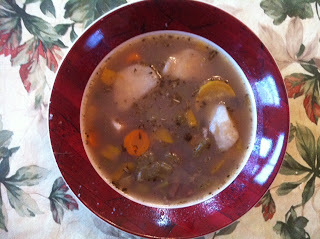

Lamb Soup
* lamb stock
* 2-3 carrots peeled, cut
* celery, chopped
* onion, chopped
* yellow pepper, chopped
* small yellow zucchini, chopped
* 2 potatos, peeled, chopped
* green beans, chopped
* rehydrated lentils
* 4-5 cloves of garlic
* coriander, rosemary and sweet basil to taste
* salt and pepper to taste

1. Bring the lamb stock to a gentle boil.
2. Add in the vegetables, garlic and spices.
3. Let boil for 15 minutes or so.
4. Reduce heat and let simmer until desired consistency is achieved.
I usually stop a number of times throughout and test the broth, often topping up the spices. You should do so as well. Lamb soup is a unique, delicious, and extremely nutritious addition to any meal.

Thinking about eating more lamb? Hill Giant Farm is taking orders for our 2012 Spring lambs. Pasture raised lamb. Here's how it works (available to those in Southern Ontario, only)
You email us at hillgiantfarm@gmail.com to let us know you are interested.

How much does it cost? Customers of Hill Giant Farm purchase the whole lamb and are charged $6.90/lb for hanging weight. 

What does hanging weight mean? This means that you pay for what the carcass weighs whole, after it is butchered, but before it is broken down into individual chops, roasts etc. In other words, individual pieces are not weighed and charged. This way you pay a flat rate for all the prime (rack) and secondary (shoulder) cuts. It is the most economical way to purchase meat. On average, the hanging weight of a carcass is in the range of 50lbs. 


Is there anything else I need to know? Yes. Our lambs are butchered at a government inspected facility only10 km from our farm. There is a $45 butchering charge. For that fee, the butcher will custom cut, wrap and label the meat to your specifications, with a guarantee that it has been done safely and humanely according to government requirements. 


.

Tuesday, 24 July 2012

Six Reasons Hill Giant Farm Needs Rain

We hate to be too "farmerish" by dedicating a whole post to why we need rain, but the simple fact is, we do. Badly. Here is a list of ten reasons why Hill Giant Farm could use some rain. Some of these might be obvious to you, but others we're hoping will shed some light onto how a farm (and things on a farm) work. 

1. Our garden is in really bad shape because of the drought. The tomatoes and pepper plants have died, the peas, beans, beets, lettuce etc. are growing much slower and the potato beetles are thriving because of the dry conditions. We'd water the garden except for reason 2. 

2. When your water comes from a well, or a spring (as in our case) you begin to think and care a lot about the aquifer that feeds it. There is a limited amount of water in the underground aquifer. As it rains, the water taken out of the aquifer is replaced. When it doesn't rain....well, you begin to run short on water. We're ok so far, but the other day we noticed that our water pressure is dropping. So, we've implemented water saving measures; all animals get watered daily (obviously, as this is essential), we try and eat foods that require limited water to prepare, we either do a load of laundry or have a shower/hair wash each day, and we only flush when absolutely necessary. Needless to say, in this kind of situation, watering a 100x50 food garden is out of the question. 

3. Pasture doesn't replenish itself when it doesn't rain. As the sheep graze down one area of the pasture we move them to another, or they move themselves. Under normal circumstances, this allows the mowed down area to grow back and replenish itself. At the moment, all we have where the sheep have already eaten is weeds and dead grass. Not very encouraging. This will mean we'll have to cut more hay. See reason 4.

4. Without a substantial amount of rain, we will not be able to do a second cut of hay. Typically farmers in Ontario try and cut hay in June/July and late August/early Sept. in order to have enough for the winter. This depends on how well the hay field replenishes itself after the first cutting. At the moment we have enough hay cut for this winter, provided we can pasture the sheep until mid Oct., which depends on reason 3. 

5. Grain requires rain in order to properly form. At the moment we have a beautiful field of oats and barley growing nicely in one of our back fields. However, they are at a standstill. The stalks have grown and the heads have formed, now we just need the seeds to form and solidify within the heads. This, no surprise, requires rain. Our grain crop is very important to us as it will form the second leg of a 2 leg feeding program for the sheep this winter. 

6. Dry ground negatively affects the electrification of our fence. We use electric fence on field perimeters to keep the sheep where we want them. We aren't 100% sure how this works, but as the ground around the ground wire on the electric fence gets drier, the fence loses power and is much less effective. This evening M watered the ground wire for 5 minutes in order to increase the fences effectiveness. That's right, she watered the fence :)

There are no doubt many people who would welcome some rain. What are your reasons for wanting rain? Tell us in the comments section. We'd love to hear from you.

Wednesday, 11 July 2012

Picture Perfect

There is so much going on at the farm this time of year. The grain field we planted is coming along nicely, the chickens are enjoying their free range lifestyle, birds are laying eggs and waiting for them to hatch, and the garden is beginning to produce. What a wonderful time early summer is! Here's some photos of life on our farm over the last few days. Enjoy!
A close up shot of some of the barley that we
planted.  In about 6 weeks it should be ready
to be harvested.


This nest of Bobolink eggs was discovered in one of our
hay fields.  Because of our discovery we will leave this field until
last in hopesthat the eggs will have had time to hatch and the
birds will have fledged.


Last year we planted buckwheat to outpace the
weeds in this years grain field. While we didn't
plant any this year, we have had several
volunteers emerge. They're lovely at this stage.
Once the white flowers turn black they are
ready to be combined.  

This lovely young lettuce is nearly big enough
to eat. It's amazing that the bunnies haven't
found it yet. Last year, only one head of
lettuce survived the bunny invasion. 
An exhausted Allis chills out on the couch. It's a lot of work
barking at every bird and moth that flies across our 100 acres!
While weeding the other evening, M discovered
that the peas are finally just about ready to eat.
The lack of rain means everything is growing
much slower than usual. 
You may not be able to tell because he has no tail feathers,
but this is one of our 2 roosters. He had a run in with Allis.
He escaped with his life, but she sure got a lot of his feathers.
Ever wonder what your oatmeal looks like before
 it's harvested? This is a nice example of oats on the
stalk. Once the stock dries it be harvested 
and fed to the sheep this winter. 

Wednesday, 4 July 2012

Wildcard Wednesday: Hay Jude....

Our hay elevator, purchased on Kijiji for $150 is a real energy saver.
75 of last years bales mark the beginnings of the pile. 
Late June and early July are an exciting, if not busy, time on the farm. It's haying season! There is, in M's opinion, nothing more beautiful than a freshly cut field of hay laying in the sun to dry. There's also nothing quite as frustrating as the inevitable breakdowns and delays that seem to accompany haying season. This year's hurtles to getting that beautiful fresh hay into the barn dry and before it rots included; a broken hay wagon courtesy of the strong winds we got this Spring and a broken clutch on the baler. However, thankfully we have great neighbours who are always ready to lend a hand. Our next door neighbour's lent us a wagon and when it became clear that the baler wasn't going to work for this particular cut of hay, they baled it for us.     As a result of their kindness and the help of our friend P McM we have 225 bales in the barn so far. A good start on the year's requirements. With 3 fields left to cut, here's hoping the baler is easily fixed. Here are a few photos of the process of putting the hay into the barn. In the first photo you will see the elevator- the machine we use to move the hay from the wagon into the barn. It acts like a big conveyor belt and is a back saver! The other two photos are a before and after of the barn/hay ratio.

What have you been up to lately at your place? Comment. We'd love to know.

2 hours later, 225 bales fill the corner of the threshing floor. 


Wednesday, 20 June 2012

Wildcard Wednesday: Wildflowers, Nature's Bouquet

Here at Hill Giant Farm we take a pretty laissez faire approach to lawn cutting- as in we don't really have a lawn, but rather one large hay field in front of our house. In about a week or so we will cut it, bale it and the sheep will add it to their winter menu. To some with more of an "in town" sensibility, I'm sure our approach to the front hay field is frustrating. But to us, it just makes sense. Can you imagine cutting 7 acres of lawn?! What a waste of yummy food for the sheep.

What may be missed at first glance is the beautiful array of gorgeous flowers that nature has deposited in this field. We have a flower shop right outside our front door. There are daisies, buttercups, poppies, hyacinth, sweet peas, red clover (beautiful and edible!), snow drops, queen anne's lace, not to mention countless ferns, alfalfa and other lovely greenery. Yes, it is a delightful surprise to go out each day and notice another beautiful flower or fern adorning the front of our house. There are so many of these beautiful, unplanted flowers that the house is often complimented by a lovely, delicate bouquet on the dining room table. Here's a picture of a recent bouquet put together by R, M and our friend SG. What flowers or surprises has nature blessed your lawn with? Tell us, we'd love to hear about it.

Tuesday, 12 June 2012

Inch by Inch, Row by Row

It's gardening season! Last evening M put the majority of our garden in. As she did so, she kept thinking of this song;  http://www.youtube.com/watch?v=D3FkaN0HQgs. While we haven't figured out how to get our flowers and veggies to sing yet, we do find the garden to be a very rewarding pursuit. In a matter of weeks our grocery bill will significantly decrease as fresh veggies begin to make up the bulk of our diet. There's also various pickles, salsas, and freezer treats to look forward to as well.

 Below is a list of our garden contents so far and some of the ways we look forward to eating it.

Potatoes: we love these mashed, baked, fried, scalloped-if you can think of a way to cook potatoes, chances are we've tried and loved it! 

Green beans: delectible cooked el dante and served with butter melted over them. Their also pretty tasty dilled and canned. We also love to freeze them and pull them out mid winter to dress up a tired pot of soup, or as a treat all on their own. 

Peas: we'd love to freeze these for a fresh treat in the winter, but truthfully, very few of them make it past the door. M eats nearly all of them on sight in the garden!

Beets: we love to pickle the root and the greens are fantastic in salad.

Onions: if it were up to M, they'd be added to everything. We mainly use them in soups and salads.

Swiss Chard: this delicious, often overlooked green is choke full of vitamin D and is great in salads, wilted with butter and garlic, frozen for use in lasagnes and soups. If you've never tried it, you really should. It's delicious, but make sure you buy it while it's small.

Cherry, Roma and Yellow Tomatoes: cherry tomatoes are great for eating and salads. As for the Roma, nothing makes better home made salsa, bruschetta in a jar, or harissa sauce than Roma tomatoes. Our mouths are watering just thinking about it. Yellow tomatoes are a tasty way to dress up a platter salad or to add unique flavour to a bacon lettuce and tomato sandwich. 

Sweet Peppers: these are great raw or sliced and frozen for easy addition to future stir fries, lasagnes, couscous casseroles and soups. 

Hot Peppers: R likes things spicy, so we dry these and he adds them throughout the year to practically everything he eats. He reminds M of his Dad!

Lettuce, Radicchio and Mesculin: there is simply nothing in the world as satisfying as a fresh salad made with brand new, perky lettuce from your own garden. So fresh and full of flavour. Don't believe us? Our local rabbit population agrees too :)

Left to plant are: carrots, radishes, cucumbers and spinach. Did all this talk about fresh food and veggies make you hungry? We hope so. We also hope it inspired you to plant some seeds of your own. Remember, whether it is a small pot of peppers on a verandah, a plot in your backyard or a full scale garden, growing your own veggies is a nutritious and delicious way to save money and improve your overall health. Now, go eat something green and leafy :)