Well, it has unintentionally been a while since the last post from Hill Giant Farm. But don't worry we're still here! September was a really hectic month-back to school, additional chores wrapping up the summer, computer problems.....lots of things to distract us from blogging :) So, here's a bit of an update on what's happening at our place:
Lamb/Sheep Update: So far this year we have secured 12 lamb orders and they are due to go to the butcher on October 30 for butchering on October 31. Guess they'll be getting a trick more than a treat! This years lambs seem to be putting on more weight than last years, so that's good news for us and for our customers. We also decided to leave the mature rams in with the ewes all summer this year so we will have earlier lambing in 2013, likely late January to mid-February. This is a new experience for us but we're excited about it.
Chicken Update: The "little birds" (this years chicks) have been pretty stressful in September. You can shoot raccoons, you can fill in holes to keep out weasels and skunks, but it sure is hard to prevent aerial predation. We lost a few chickens to the goss hawk that built her nest in the nearby county forest. Frustrating, and as a result we made the philosophical decision that for the overall health of the little birds we would stop letting them out on pasture to eat freely what they like and would start feeding them inside again. They're doing much better inside and are showing less signs of stress.
Frank: Our duck Frank seems to be doing pretty well. There has been much discussion among the Grey County relatives as to the sex of Frank. The matriarch of the Grey County family believes that Frank is a drake (male) based on the way its tail feathers display themselves (turned up instead of flat), while the oldest uncle in the family believes Frank is a duck (female) based on the same trait. Only time will tell as Frank will either lay eggs or not.
Kittens: Our mother cat and her remaining 3 kittens moved outside in September. Since then, the tom cat kitten has moved on and so has the mother cat. However, two of the kittens-Flopsy and Mopsy- have moved into the barn. We've noticed a great benefit from having the cats around this year; no rodents when we mucked out the sheep pen. That's a first!
As for us people at Hill Giant Farm, well, we just keep on plugging away. We enjoyed a 5 day vacation to the States with our Lambton County family. A fabulous couple farm sat for us and it was great to get away together. Well, that's all for now. Check back on Monday for a yummy recipe.
Saturday, 20 October 2012

Wednesday, 5 September 2012
Wildcard Wednesday: Transition Network
 On Monday we set out on what we thought would be a quick trip to pick up a 10 stall nesting box for our chickens. Little did we know that we were picking it up at a full fledged rare breed poultry breeding farm (there were birds and poop everywhere. M's Dad would have hated it!) We found the box on Kijiji, and as seems to often be the case, once we were there we found we had a lot of common interests with the farmer selling the boxes to us.
Over time, the conversation which began with lots of advice on how to raise poultry and recommendations about breeds etc., turned to discussion of bigger issues such as the inability to locally sustain small farms, difficulties around processing livestock on small numbers, the globalisation and industrialisation of farming,and where the future might take us as North Americans. In this discussion (frequently interrupted by turkeys trying to climb into our truck! They were really persistent!) we were introduced to the Transition Network, and in particular, Transition Meaford. We're still reading about them and learning what they're all about, so it's too soon to say what our involvement with them might or might not be. It looks like they are trying to plan ahead for a time when our current lifestyle- heavily reliant on oil to get us where we need to go, and to get most of what we eat and drink to our tables, becomes unfeesible or unsustainable. The Transition Network seems to be trying to come up with solutions to these sorts of problems and to implement policies and structures that will ease that transition. That makes sense to us.
On the Transition Meaford business card we were given, they asked some great questions. Below are two that we'd love to hear your opinion on. Each person who responds will have their name entered into a contest for a great Hill Giant prize.
 1.How can we educate children for a world different from ours?
2. How will we feed ourselves in the future?
These are important questions to ask no matter what your politics, religion or worldview. The only thing we know is inevitable, is change. Socieites and cultures are constantly changing, so why not spend some time considering how it might change.
We look forward to your responses!
Friday, 24 August 2012
Frugal Friday: Fish in a Barrel
Recently a friend of ours who lives in town was commenting on an increase in their water rates. While water is still a fairly affordable utility, they were discussing whether or not they really wanted to spend water on watering their flower beds and garden etc. There's a really affordable solution to that; a rain barrel.
Making a rain barrel is really quite simple. Lots of re-stores, restaurants or stores have barrels that they are willing to get rid of cheap. Or, if you aren't sure where you could get one for free or cheap, there are several nice models available at Home Hardware, Rona or Home Hardware. Stick one of these under your downspout and voila! instant free, soft water for your garden. We've had one for several years now and it's great...as long as there's rain.
While setting up the rain barrel is easy there is one major thing that needs to be considered. Open, warm water (like what collects in a rain barrel) is a prime breeding ground for mosquito larvae. This isn't really what anyone wants in their yard. The solution to this problem is simple too: feeder goldfish. We have 12 in ours and their doing a great job gobbling up the mosquitoes and their eggs. We spent a total of $3.84 on our fish. When you get the fish, don't forget that you have to give them time to adjust to the temperature of the water before fully releasing them. Simply place the bag in which you bought the fish in the rain barrel and leave it there for 30 minutes. This will provide lots of time for the internal temperature of the fish to gradually adjust. After 30 minutes the fish can be released into the barrel.
Being frugal doesn't have to be complicated. Sometimes its a simple as a barrel under a downspout. What ideas or tips have you come up with for saving money? Share them in the comments. We'd love to hear from you!
Making a rain barrel is really quite simple. Lots of re-stores, restaurants or stores have barrels that they are willing to get rid of cheap. Or, if you aren't sure where you could get one for free or cheap, there are several nice models available at Home Hardware, Rona or Home Hardware. Stick one of these under your downspout and voila! instant free, soft water for your garden. We've had one for several years now and it's great...as long as there's rain.
 |
| It is important to allow time for the fish to adjust their body temperature before releasing them into the barrel. |
 |
| Some of the fish getting used to their new home. |
Wednesday, 22 August 2012
Wildcard Wednesday: Logo
We are really lucky at Hill Giant Farm to have so many friends, talented in so many things. Recently, a friend of ours who operates her own Graphic Design company created a logo for Hill Giant Farm. We're really happy with it and thought we'd share it here.


Saturday, 18 August 2012
Frugal Friday: Canning Season
 |
| Yummmmm!!!! |
Today we received our first "canning commission" to make salsa for a friend who is going to purchase the veggies needed, but doesn't have the time or desire to make it themselves. Great deal for us (because this farm might actually generate some money) and a great deal for them, as they will enjoy yummy salsa made from local ingredients for less than they can buy it at the grocery store.
For ourselves, the canning plans and dreams for this year go something like this; pesto with the basil we've been growing, bruschetta in a jar (it is beyond delicious!), peaches/pears (depending on which we can find), beets, dilled beans and possibly some pickles. Mmmmmm, we're drooling just thinking about it.
If any of you would like to enjoy yummy canned treats made from local ingredients, drop us a line at hillgiantfarm@gmail.com, we could still take a few more comissions. Or, if you want to try canning yourself, and just need some help getting started, M would be glad to answer any questions you might have or offer tips through the same email address. Don't be shy, drop us a line. Thanks for reading!
Wednesday, 15 August 2012
Wildcard Wednesday: Garden Update
 Howdy faithful reader(s), this blog post comes to you via Hill Giant Farm's new iPad. Horray for technology!!
Its been a while since we've written about our garden because, to be honest, a post about vegetables growing would be pretty dull. But today, at long last, we managed to harvest something's from our garden. Like most things on our farm, the garden really suffered as a result of the month along drought in July. We lost all our tomatoes (except for 5 drought resistant Mexican tomatillos), our peppers and eggplant, and our pease have been seriously stunted by the lack of rain. Throw in some anibbling bunnies, and today's harvest was a pleasant surprise. After 2 hours of weeding we see pleased to harvest from the garden today; 1 pound of green beans (and there are PLEANTY more), a huge bunch of Swiss chard, some beautiful lettuce (take that bunnies!!) and a few peas. We're looking forward to our beets in about 2 weeks. Before long it will be time to can/jar/freeze up the rest of our bounty. What a great time of year!
In other farm news, the chickens took the month of July off from egg laying, probably because it was so hot and dry. So we actually had to buy eggs, and tell our customers to do the same (cringe). But, yesterday we found some eggs- we've had 21 since yesterday. It's been a good day overall at Hill Giant Farm. How about at your house?
Monday, 6 August 2012
Mmmm Monday: Lamb Soup
Over the last few weeks we've been asked if we could post more lamb related recipes on this blog. It seems that some of you might be interested in purchasing and eating lamb, if you only knew how to prepare it. We want to encourage you in your lamb eating! So, here is a recipe for some yummy soup. There are two parts; how to make the stock that will form the base of your soup, and the recipe for the soup itself.
 Lamb Stock
* soup bones or other left over bones from a lamb carcass
* water to cover bones
* 1 medium sized onion
* 2-4 large carrots
* the bottom 5 inches of a whole bunch of celery (not the individual stocks)
* peppercorns and salt (to taste)
* coriander and rosemary (to taste)
1. Thaw out your soup bones or other bones and place in a large stock pot or other large pot. Completely cover the bones with water.
2. Begin boiling on high.
3. As you begin to boil, add the onion (do not peel, or cut), the carrots (again, no need to peel or cut) and the celery. The purpose of these vegetables is to infuse flavour and nutrients into the stock.
4. Add in your peppercorns, salt, coriander, and rosemary.
5. Once you have achieved a rolling boil for about 10-15 minutes, reduce heat to med/low and let simmer until stock reaches desired thickness and taste.
6. Once your desired thickness and taste is achieved, strain the stock into another large pot. Discard vegetable remnants (they make great chicken feed or compost!). Pick up the bones, one at a time, and pick them clean- adding meat to your stock and discarding fat, cartiledge and bone.
You now have the base for a delicious lamb soup! It can be stored in a jar in the fridge for later, frozen, or used immediately.
Deal for Local Readers! Many of you are no doubt thinking that you don't have time to make lamb stock. That's probably true! It does take a while. For those of you who live local to Hill Giant Farm, we have an offer you don't want to miss. We have 2 1L jars, and 2 500ml jars of lamb stock left over from this evenings supper. We have canned it up and are willing to sell it for $4/1L of $2/500ml to the first people to email us at hillgiantfarm@gmail.com. Please let us know how many jars you would like, and what size. Thanks!
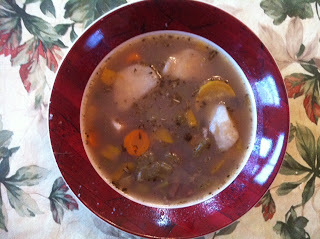
Lamb Soup
* lamb stock
* 2-3 carrots peeled, cut
* celery, chopped
* onion, chopped
* yellow pepper, chopped
* small yellow zucchini, chopped
* 2 potatos, peeled, chopped
* green beans, chopped
* rehydrated lentils
* 4-5 cloves of garlic
* coriander, rosemary and sweet basil to taste
* salt and pepper to taste
1. Bring the lamb stock to a gentle boil.
2. Add in the vegetables, garlic and spices.
3. Let boil for 15 minutes or so.
4. Reduce heat and let simmer until desired consistency is achieved.
I usually stop a number of times throughout and test the broth, often topping up the spices. You should do so as well. Lamb soup is a unique, delicious, and extremely nutritious addition to any meal.
Thinking about eating more lamb? Hill Giant Farm is taking orders for our 2012 Spring lambs. Pasture raised lamb. Here's how it works (available to those in Southern Ontario, only)
You email us at hillgiantfarm@gmail.com to let us know you are interested.
How much does it cost? Customers of Hill Giant Farm purchase the whole lamb and are charged $6.90/lb for hanging weight.
What does hanging weight mean? This means that you pay for what the carcass weighs whole, after it is butchered, but before it is broken down into individual chops, roasts etc. In other words, individual pieces are not weighed and charged. This way you pay a flat rate for all the prime (rack) and secondary (shoulder) cuts. It is the most economical way to purchase meat. On average, the hanging weight of a carcass is in the range of 50lbs.
Is there anything else I need to know? Yes. Our lambs are butchered at a government inspected facility only10 km from our farm. There is a $45 butchering charge. For that fee, the butcher will custom cut, wrap and label the meat to your specifications, with a guarantee that it has been done safely and humanely according to government requirements.
.
 Lamb Stock
* soup bones or other left over bones from a lamb carcass
* water to cover bones
* 1 medium sized onion
* 2-4 large carrots
* the bottom 5 inches of a whole bunch of celery (not the individual stocks)
* peppercorns and salt (to taste)
* coriander and rosemary (to taste)
1. Thaw out your soup bones or other bones and place in a large stock pot or other large pot. Completely cover the bones with water.
2. Begin boiling on high.
3. As you begin to boil, add the onion (do not peel, or cut), the carrots (again, no need to peel or cut) and the celery. The purpose of these vegetables is to infuse flavour and nutrients into the stock.
4. Add in your peppercorns, salt, coriander, and rosemary.
5. Once you have achieved a rolling boil for about 10-15 minutes, reduce heat to med/low and let simmer until stock reaches desired thickness and taste.
6. Once your desired thickness and taste is achieved, strain the stock into another large pot. Discard vegetable remnants (they make great chicken feed or compost!). Pick up the bones, one at a time, and pick them clean- adding meat to your stock and discarding fat, cartiledge and bone.
You now have the base for a delicious lamb soup! It can be stored in a jar in the fridge for later, frozen, or used immediately.
Deal for Local Readers! Many of you are no doubt thinking that you don't have time to make lamb stock. That's probably true! It does take a while. For those of you who live local to Hill Giant Farm, we have an offer you don't want to miss. We have 2 1L jars, and 2 500ml jars of lamb stock left over from this evenings supper. We have canned it up and are willing to sell it for $4/1L of $2/500ml to the first people to email us at hillgiantfarm@gmail.com. Please let us know how many jars you would like, and what size. Thanks!

Lamb Soup
* lamb stock
* 2-3 carrots peeled, cut
* celery, chopped
* onion, chopped
* yellow pepper, chopped
* small yellow zucchini, chopped
* 2 potatos, peeled, chopped
* green beans, chopped
* rehydrated lentils
* 4-5 cloves of garlic
* coriander, rosemary and sweet basil to taste
* salt and pepper to taste
1. Bring the lamb stock to a gentle boil.
2. Add in the vegetables, garlic and spices.
3. Let boil for 15 minutes or so.
4. Reduce heat and let simmer until desired consistency is achieved.
I usually stop a number of times throughout and test the broth, often topping up the spices. You should do so as well. Lamb soup is a unique, delicious, and extremely nutritious addition to any meal.
Thinking about eating more lamb? Hill Giant Farm is taking orders for our 2012 Spring lambs. Pasture raised lamb. Here's how it works (available to those in Southern Ontario, only)
You email us at hillgiantfarm@gmail.com to let us know you are interested.
How much does it cost? Customers of Hill Giant Farm purchase the whole lamb and are charged $6.90/lb for hanging weight.
What does hanging weight mean? This means that you pay for what the carcass weighs whole, after it is butchered, but before it is broken down into individual chops, roasts etc. In other words, individual pieces are not weighed and charged. This way you pay a flat rate for all the prime (rack) and secondary (shoulder) cuts. It is the most economical way to purchase meat. On average, the hanging weight of a carcass is in the range of 50lbs.
Is there anything else I need to know? Yes. Our lambs are butchered at a government inspected facility only10 km from our farm. There is a $45 butchering charge. For that fee, the butcher will custom cut, wrap and label the meat to your specifications, with a guarantee that it has been done safely and humanely according to government requirements.
.
Subscribe to:
Posts (Atom)